
EV Charging Station Power Module Market Overview
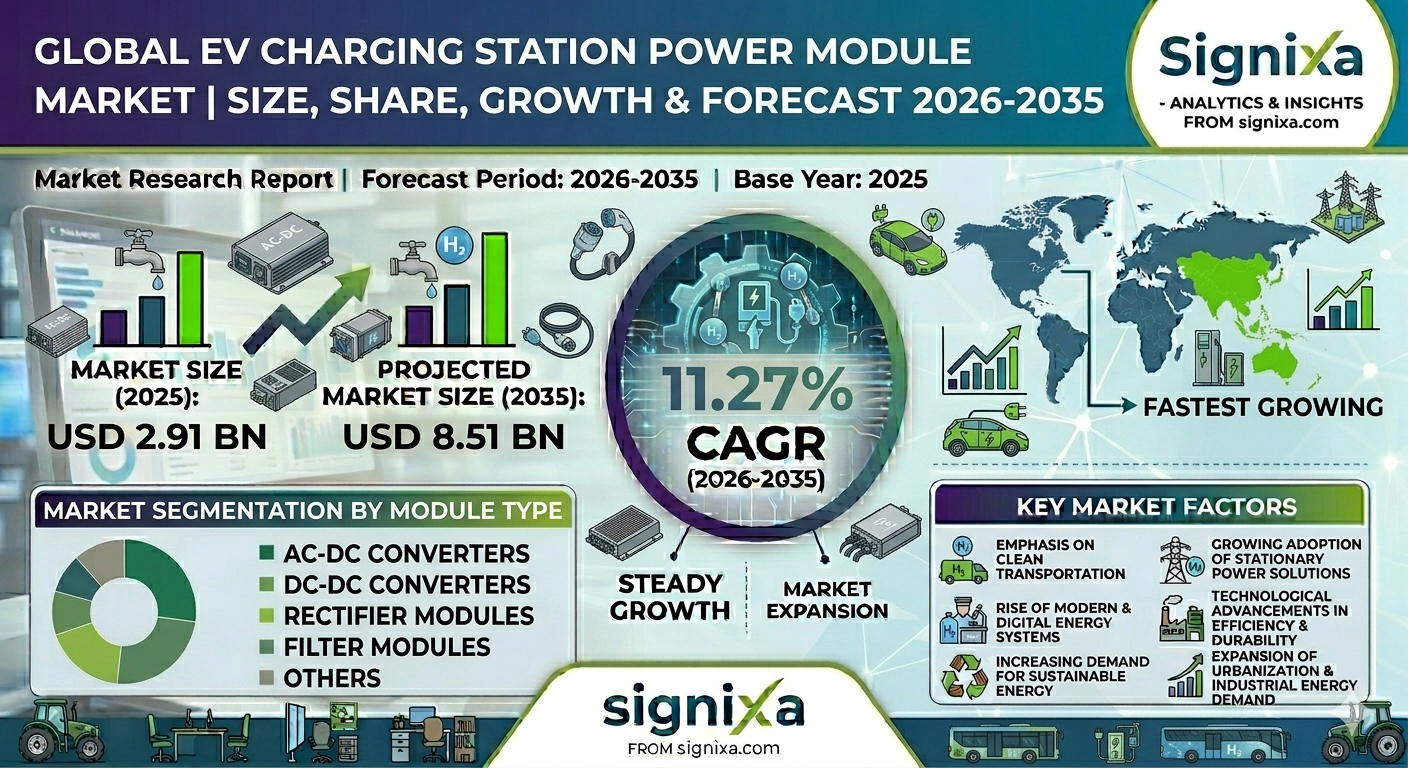
The size of the global EV Charging Station Power Module market was valued at approximately USD 2.91 Billion in 2025 and is projected to reach around USD 8.51 billion by 2035, growing at a compound annual growth rate (CAGR) of roughly 11.27% between 2026 and 2035. The report provides an in-depth analysis of the key trends, market dynamics, and strategic outlook shaping the EV Charging Station Power Module market.
The EV Charging Station Power Module market comprises technology components that deliver and manage power in electric vehicle (EV) charging stations. The market is gaining traction due to rising EV adoption, expanding public charging infrastructure, and demand for faster, more reliable charging modules. Governments and utilities are investing in grid-ready solutions to support charging loads. Simultaneously, fleet operators and private users are integrating efficient power modules to improve turnaround and lower energy costs.
Key Findings
- The global EV Charging Station Power Module market is projected to grow at a CAGR of 11.27% between 2026 and 2035.
- The market size is expected to increase from USD 2.91 Billion in 2025 to USD 8.51 billion by 2035.
- DC Charging Modules are anticipated to dominate the market due to higher power delivery capabilities.
- Fast Charging is projected to hold the largest market share by charging speed category.
- Public Charging Stations remain the largest application segment.
- Commercial users are the leading end-user group for EV power modules.
- Asia-Pacific is likely to remain the fastest-growing region, while Europe and North America maintain steady demand due to regulatory and policy support.
EV Charging Station Power Module Market Dynamics
Decarbonization, Smart Mobility & Grid-Integrated Power Module Demand
The growing global focus on decarbonization and electrification of transport is driving investment in robust and scalable EV Charging Station Power Modules. As cities roll out smart mobility initiatives, charging stations must accommodate diverse usage needs. Power modules must support rapid load changes, grid interactions, and communication with back-end systems. These technical demands are pushing OEMs to develop intelligent, grid-integrated modules that ensure reliable and efficient charging.
Government Policy Support — NEVI Funding, EU AFID & National EV Mandates
Another key factor propelling market growth is government support and policy mandates aimed at expanding electric vehicle infrastructure. Countries across North America, Europe, and Asia are offering tax breaks, subsidies, and grants for public and private EV charging installations. This has encouraged utilities and commercial real estate developers to integrate advanced charging modules to future-proof their infrastructure. Additionally, initiatives like the EU's Alternative Fuels Infrastructure Directive (AFID) and U.S. NEVI funding are fuelling demand.
EV Charging Station Power Module Market Segmentation Analysis
By Technology Type Segment Analysis: AC, DC & Wireless Charging Modules
AC Charging Modules 3.7–22 kW
AC Charging Modules are widely used in residential and commercial spaces, accounting for over 35% of the market share in 2025. They are cost-effective and easy to install, making them suitable for daily charging needs. AC modules typically support power levels between 3.7 kW and 22 kW, ideal for overnight or workplace use.
DC Charging Modules 50–350 kW
DC Charging Modules dominate with nearly 50% share in 2025. DC modules offer faster charging speeds (50 kW to 350 kW), making them essential for highway corridors and urban public charging stations. Increasing deployment of ultra-fast chargers has significantly boosted demand.
Wireless Charging Modules
A niche segment with less than 10% share in 2025, wireless modules are gaining interest in premium and autonomous vehicle markets. These modules use inductive charging and are ideal for fleet and robotic applications, with convenience as their key selling point.
By Charging Speed Segment Analysis: Slow, Fast & Ultra-Fast Charging
Slow Charging <7 kW
The Slow Charging segment accounted for 25% of the market in 2025, mainly used in residential or overnight applications. Slow chargers (<7 kW) are being phased out in favour of faster alternatives, though they remain relevant in cost-sensitive markets.
Fast Charging 7–50 kW
Fast Charging represents over 55% share in 2025. Fast chargers (7 kW to 50 kW) are widely used across public and workplace settings. Their balance of speed and infrastructure compatibility makes them a preferred choice across diverse installation environments.
Ultra-Fast Charging >100 kW
Ultra-Fast Charging has nearly 20% share in 2025 and this segment is rapidly expanding, supported by government-backed highway charging projects and demand from EV fleets. Chargers in this segment typically exceed 100 kW and can recharge vehicles in under 30 minutes.
By Application Segment Analysis
Public Charging Stations
Public Charging Stations is the largest application, holding over 45% share in 2025. Governments and private players are investing in accessible urban charging infrastructure, contributing to growing deployments across cities, highways, and transit hubs.
Private Charging Stations
Comprising 30% share, this segment includes home and residential complexes. Rising EV ownership and integration with smart home systems are boosting demand for private charging infrastructure equipped with intelligent power modules.
Fleet Charging Solutions
Fleet Charging Solutions has 15% market share in 2025. Logistics, e-commerce, and public transport fleets are embracing modular power units to ensure fast, efficient turnaround times, driving significant demand for high-capacity charging modules.
Workplace Charging Solutions
Holding a 10% share, this segment is gaining traction among corporates promoting green mobility for employees and meeting sustainability goals. Workplace charging deployment is accelerating as companies integrate EV benefits into employee packages and ESG strategies.
By End User Segment Analysis
Commercial Users
Commercial Users dominate the segment with 40% market share. Commercial users include parking operators, malls, hotels, and offices. They seek scalable, high-performance modules to meet diverse customer needs and maximize charging station uptime.
Residential Users
Residential Users account for nearly 30% share, driven by rising EV penetration and government incentives for home charging installation. The adoption of smart home integration and time-of-use electricity pricing is encouraging investment in residential power modules.
Government Institutions
Government Institutions hold around 20% market share in 2025. Public sector agencies are adopting power modules in infrastructure projects aligned with national EV strategies, including government fleet electrification and public transit charging initiatives.
Utility Companies
Utility Companies comprising 10% share are integrating charging stations into grid systems, deploying power modules capable of load balancing and demand response. Their involvement is critical for enabling vehicle-to-grid (V2G) and bi-directional charging capabilities.
Report Attributes & Market Scope
| Report Attribute | Details |
|---|---|
| Market Size Value in 2024 | USD 2.91 Billion |
| Market Size Value in 2032 | USD 8.51 Billion |
| CAGR (2026–2035) | 11.27% |
| Base Year Used for Estimation | 2025 |
| Historic Data | 2020-2024 |
| Forecast Period | 2026-2035 |
| Segments Covered — By Technology Type |
|
| Segments Covered — By Charging Speed |
|
| Segments Covered — By Application |
|
| Segments Covered — By End User |
|
| Regions Covered | North America, Europe, Asia Pacific, Latin America, Middle East and Africa |
| Major Countries Covered | U.S., Canada, Mexico, Germany, UK, France, Italy, Spain, Russia, China, Japan, South Korea, India, Southeast Asia Countries, Brazil, Argentina, GCC Countries, Turkey, Iran, Israel, South Africa, Egypt, Nigeria, etc. |
| Key Companies Profiled | ABB, Siemens, Delta Electronics, Schneider Electric, Eaton, Infineon Technologies, Tesla Inc., Wallbox Chargers, Blink Charging, and Tritium, among others. |
EV Charging Station Power Module Market Regional Analysis
Asia-Pacific leads the global EV Charging Station Power Module market, driven by strong EV policies in China, South Korea, and India. The region accounted for over 40% of global revenue in 2025. North America and Europe are also significant markets, with Europe benefiting from strict carbon emission regulations and North America receiving infrastructure funding support. Latin America and the Middle East & Africa are emerging markets, where government-led electrification programs are stimulating growth.
Asia-Pacific (Market Leader & Fastest Growing)
Asia-Pacific leads the global EV Charging Station Power Module market, driven by strong EV policies in China, South Korea, and India. China is the world's largest EV market, with massive government investment in public charging networks, EV mandates for automakers, and incentives for charging infrastructure developers. South Korea and Japan are advancing high-power charging technology, while India's rapidly growing EV ecosystem and government FAME schemes are accelerating demand. The region's large manufacturing base also supports competitive production and deployment of power modules at scale.
Europe
Europe is a significant market for EV Charging Station Power Modules, benefiting from strict carbon emission regulations, the EU's Alternative Fuels Infrastructure Directive (AFID), and aggressive net-zero targets. Countries like Germany, France, the UK, Norway, and the Netherlands are leading in EV adoption, supported by extensive public charging networks and strong manufacturer EV commitments. European utilities are integrating smart power modules with grid management systems, and the push toward vehicle-to-grid (V2G) capabilities is opening new opportunities for bi-directional charging modules.
North America
North America maintains steady and growing demand for EV Charging Station Power Modules, driven primarily by the U.S. National Electric Vehicle Infrastructure (NEVI) program, which has allocated significant federal funding to build out a nationwide EV charging network. The Inflation Reduction Act (IRA) further incentivizes EV adoption and charging infrastructure investment. Canada's Zero-Emission Vehicle (ZEV) mandate and growing corporate sustainability commitments are also boosting demand. Commercial real estate developers, parking operators, and fleet managers are integrating advanced power modules to meet rising EV charging needs.
Latin America
Latin America is an emerging market for EV charging infrastructure, where government-led electrification programs are stimulating growth. Brazil and Chile are the leading markets, driven by urban EV initiatives, public transit electrification, and growing international automotive investment. Brazil's flex-fuel vehicle heritage is transitioning toward electrification, while Chile's commitment to carbon neutrality is driving EV infrastructure expansion. Affordability and grid reliability remain key considerations in shaping power module adoption across the region.
Middle East & Africa
The Middle East & Africa is witnessing gradual adoption of EV charging infrastructure, primarily driven by smart city initiatives in GCC countries such as the UAE, Saudi Arabia, and Qatar. These nations are integrating EV charging into ambitious urban development projects, and national EV strategies are beginning to take shape. South Africa is the most advanced EV market on the African continent, while Egypt and Morocco are emerging as focal points for EV infrastructure development. Consistent electricity supply and high infrastructure investment costs remain challenges, but improving conditions are gradually creating opportunities for power module vendors.
Recent Developments in the EV Charging Station Power Module Market
-
2023
Delta Electronics introduced a new line of modular DC fast charging solutions with integrated power management, featuring advanced thermal management systems and scalable architecture for both standalone and networked charging station deployments.
-
2022
ABB launched its Terra 360, a high-power charger capable of delivering 100 km of range in under three minutes, setting a new benchmark for ultra-fast EV charging performance and establishing ABB's leadership in the premium high-speed charging segment.
EV Charging Station Power Module Market: Competitive Landscape
Key players in the EV Charging Station Power Module market include ABB, Siemens, Delta Electronics, Schneider Electric, Eaton, Infineon Technologies, Tesla Inc., Wallbox Chargers, Blink Charging, and Tritium. These companies are focusing on scalable designs, digital monitoring capabilities, and energy management features. Strategic partnerships and acquisitions are common, helping firms expand geographical reach and product portfolios. As competition intensifies, innovation in thermal management, bi-directional charging, and smart grid integration will shape future growth.
Key Companies Profiled
Global EV Charging Station Power Module Market Segmentation Summary
By Technology Type
By Charging Speed
By Application
By End User
By Region
Frequently Asked Questions (FAQs): EV Charging Station Power Module Market
What is an EV Charging Station Power Module?
An EV Charging Station Power Module is a key electrical component used in electric vehicle (EV) charging stations to regulate, convert, and deliver the required amount of power to EVs. These modules support various charging speeds and technologies, such as AC, DC, and wireless systems, ensuring efficient and reliable vehicle charging across public, private, and commercial applications.
Which key factors will influence the EV Charging Station Power Module market growth over 2026-2035?
The market is expected to grow due to surging EV adoption, expansion of public and fleet charging infrastructure, and strong government policies promoting e-mobility. Technological advancements in power module efficiency, grid integration, and thermal management are further boosting market expansion.
What will be the value of the EV Charging Station Power Module market during 2026-2035?
According to the study, the global EV Charging Station Power Module market size was valued at approximately USD 2.91 Billion in 2025 and is projected to reach around USD 8.51 billion by 2035.
What will be the CAGR value of the EV Charging Station Power Module market during 2026-2035?
The compound annual growth rate (CAGR) of the global EV Charging Station Power Module market is estimated to be around 11.27% from 2026 to 2035.
Which region will contribute notably towards the EV Charging Station Power Module market value?
Asia-Pacific is projected to lead the market, driven by aggressive EV policies in countries like China, India, and South Korea. North America and Europe will also contribute significantly due to infrastructure funding and environmental regulations.
Which are the major players leveraging the EV Charging Station Power Module market growth?
Key players in the market include ABB, Siemens, Delta Electronics, Schneider Electric, Eaton, Infineon Technologies, Tesla Inc., Wallbox Chargers, Blink Charging, and Tritium. These companies are investing in scalable, smart power module technologies and expanding their global presence through partnerships and product innovation.
What can be expected from the global EV Charging Station Power Module market report?
The report provides an in-depth analysis of current and emerging market trends, key growth drivers, restraints, and challenges. It includes comprehensive segmentation, regional insights, and competitive landscape analysis, helping stakeholders understand strategic opportunities and market positioning.